Drainage Control
Why Does Water Sit in the Same Spot in Your Yard After Every Rain?
Giving Hope Lawn Management • October 2026 • Richmond, Glen Allen & Mechanicsville, VA • 8 min read
Short Answer: Water that pools in the same place after every rain is almost never random. In the Richmond area it usually traces to one of five causes: heavy Piedmont clay that will not accept water fast enough, a grade that sends runoff toward the spot instead of away, downspouts discharging right at the foundation, a compacted layer left behind by construction, or an existing drain line that has clogged or collapsed. The plants growing there will often tell you which one you have before anyone puts a shovel in the ground.
Most drainage calls we get start the same way. There is one spot in the yard that stays wet. It was soft in the spring, it held a puddle through the summer storms, and now with fall rain it has gone back to being a problem. The grass there is thin or gone, the mower leaves ruts, and nobody is quite sure why that particular corner is the one.
It is not random and it is usually diagnosable. Before anyone quotes you on digging, it is worth understanding what is actually happening, because the right fix depends entirely on the cause and the wrong fix is expensive.
Start With Our Soil
Most of the Richmond area sits on Piedmont clay, and clay is the background condition behind a large share of drainage complaints here. The particles are extremely fine and flat, so they pack together with very little pore space, and pore space is what water moves through.
The practical effect is a low infiltration rate. Sandy soil might absorb several inches of rain an hour. Compacted clay can be down around a tenth of an inch. When a Virginia thunderstorm drops two inches in forty minutes, the soil is not the limiting factor for a while, it is essentially not a factor at all. The water has to go somewhere on the surface.
East of the city, out toward Sandston and into the coastal plain, the picture shifts to sandy loam over clay, which behaves differently. Water moves quickly through the sandy layer and then stalls at the clay boundary, which can leave the lower root zone saturated while the surface looks dry. Different mechanism, same soggy result.
Clay also swells when wet and shrinks when dry, so infiltration is worse during a wet stretch than during a dry one. That is why a spot can seem fine in August and become a swamp in November.
Let the Plants Tell You
This is the diagnostic step most homeowners skip, and it is free. Plants are honest about soil conditions because they cannot live where conditions do not suit them.
Rushes and sedges are the clearest signal. Soft rush grows in dense round clumps of stiff upright stems. Nutsedge looks like grass but grows faster, stands taller than the turf a few days after mowing, and has a triangular stem you can feel by rolling it between your fingers. Both are wetland plants. If they have colonized an area, that soil is staying saturated long enough for wetland species to outcompete your fescue.
Moss is the second signal, though it is less specific. Moss indicates persistent surface moisture, often combined with shade and compaction. It tells you water is sitting, not necessarily why.
Then look at what is missing. Bare soil, thin patchy turf, or algae and a slick green film on the surface all point to soil that stays wet long enough to suffocate roots. Grass roots need oxygen, and saturated soil has none available.
The useful part is timing. These indicators develop over seasons, so they tell you about a chronic condition rather than about last week's storm. A patch of rushes means this has been going on for a while.
Check Where the Water Is Coming From
Standing water is a symptom of arrival plus failure to leave. People focus on the leaving part and skip the arriving part, which is often where the actual problem is.
Downspouts are the most common culprit and the easiest to verify. A typical Richmond area roof sheds an enormous volume in a single storm, and a downspout dumping at the foundation concentrates all of it in one place. Walk outside during the next rain and watch where each one discharges. If the answer is directly onto the ground within a few feet of the house, you have found a contributor.
Grade is the second. Water moves downhill, and the ground should fall away from your foundation for the first several feet. On properties where soil has settled over the years, or where landscaping beds have been built up against the house, the grade can quietly reverse and start directing water inward.
Neighboring property is the third and the most awkward. On sloped lots, runoff from uphill lands on you regardless of what you do, and that changes the conversation from redirecting your water to managing someone else's volume.
Sump pump and AC condensate discharge round it out. Both run for extended periods and both frequently discharge into the same tired spot year after year.
Construction Compaction
If your home is in one of the newer developments around Glen Allen, Mechanicsville, or the Short Pump corridor, this deserves particular attention.
During construction, topsoil is stripped and heavy equipment works the clay subsoil for months, frequently when it is wet, which is when clay compresses most severely. A thin layer of topsoil and sod goes over the top afterward. The lawn looks finished on closing day, and the compacted layer sits a few inches down behind it.
Water reaching that layer stops. It either sits above it, saturating the root zone, or runs sideways along it and emerges somewhere downhill, which is why a wet spot sometimes appears nowhere near where the water actually entered the ground.
Test it with a screwdriver. Push a six inch screwdriver into the soil a day or two after rain, when the ground is moist but not saturated. If you have to lean on it, or it stops at two or three inches, compaction is part of your picture. Try it in the wet area and in a spot that drains fine, since the comparison is more informative than either reading alone.
Existing Drainage That Has Failed
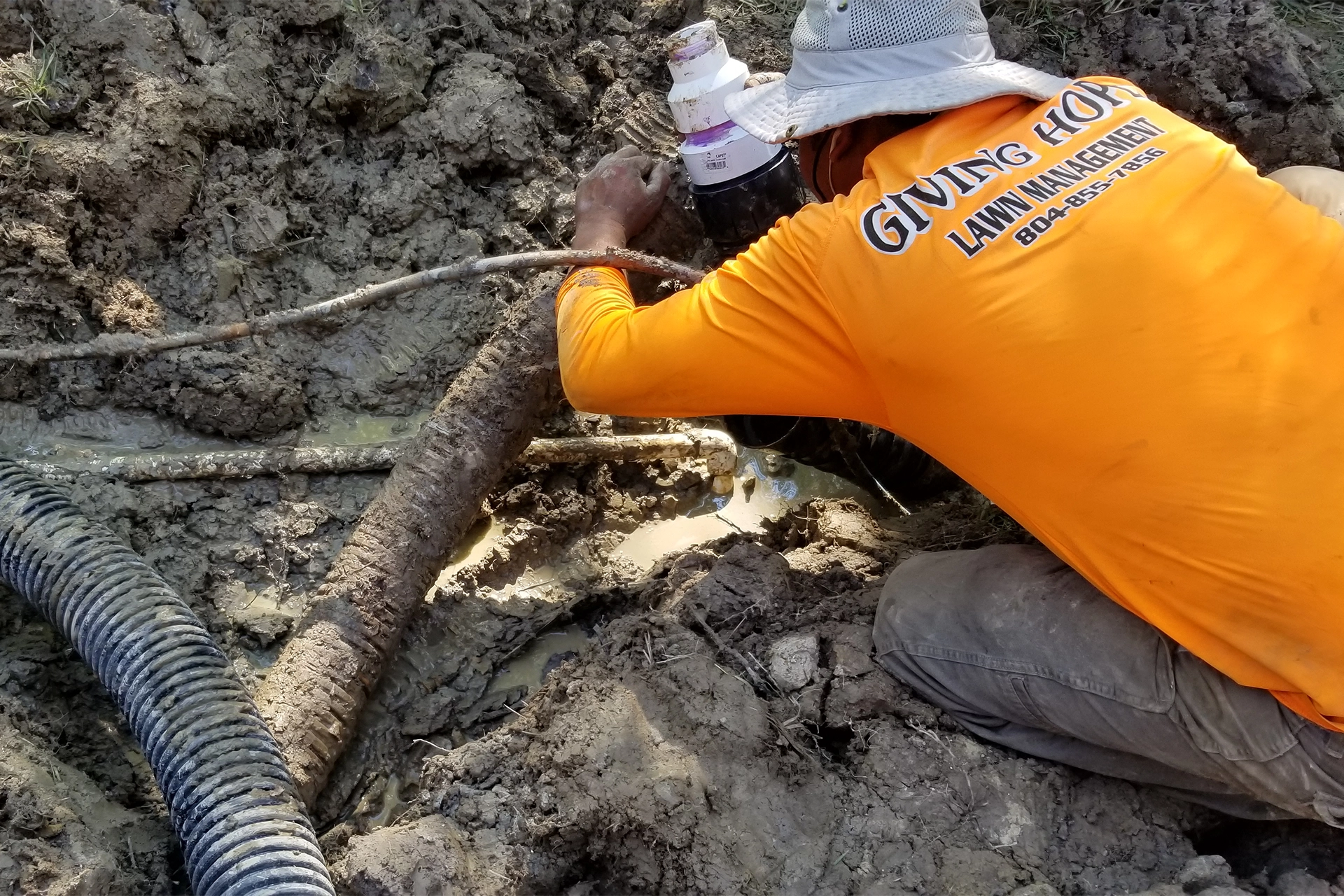
This one catches people because they do not know they have drainage at all. Plenty of Richmond area properties have existing systems installed by a previous owner or a builder, and those systems fail quietly.
Corrugated pipe crushes under traffic or settles out of grade. Solid pipe fills with silt over the years. Tree roots find perforated pipe and grow into it, because a drain line is exactly what a root is looking for. Outlets get buried under mulch or grow over with turf until nothing can discharge.
The clue is a wet area that used to be fine. If a spot drained acceptably for years and then started holding water, an existing line failing is a strong candidate, and that is a very different job from installing something new.
Walk your property line and low areas looking for an outlet. A pop up emitter, a pipe end at a ditch, or a grate in a low spot all indicate a system exists. If you find an outlet and nothing comes out of it during a hard rain, you have learned something valuable.
Why Fall Is the Right Time to Sort This Out
October is a good month for this work in central Virginia, and for reasons beyond convenience.
The ground is workable. Summer has dried things enough that equipment can operate without tearing up the yard, and we have not reached the saturated conditions that make winter and early spring excavation destructive on clay.
It is also ahead of the wet season. Our wettest, most persistent saturation generally comes in late winter and spring, so getting a system in now means it is working when you need it most rather than being installed in response to damage that already happened.
And turf recovery matters. Fescue, which is what most lawns here are, is in its strongest growth period in fall, so areas disturbed by trenching knit back together far faster now than they would in July.
What to Do Next
Go outside during the next real rain, which is the single most useful thing you can do. Watch where water enters the yard, where it travels, and where it stops. Ten minutes in a rain jacket tells you more than an hour of looking at a dry lawn.
Then check the plants in the wet area for rushes, nutsedge, or moss, push a screwdriver into the soil there and in a dry area for comparison, and follow each downspout to see where it actually discharges.
Take photos while the water is standing. This matters more than people expect, because by the time anyone comes to look, the yard has often dried and the evidence is gone. A photo of the puddle at its worst, with something in frame for scale, is genuinely useful for designing a fix.
If you would rather have someone read the property and tell you what is actually causing it before anything gets dug, we are here for that. Call Giving Hope Lawn Management at 804-405-0211 or visit givinghopelawn.com. We serve Richmond, Glen Allen, Mechanicsville, Sandston and the surrounding area.